Fair value gaps that count their own history: how often and how fast comparable gaps filled on this symbol, and whether retesting them beat random entries
Edolab Premium · $14.99/month or $149.99/year
Don't have TradingView yet? Sign up here and get $15 off your next plan.
Affiliate link
 1 / 7
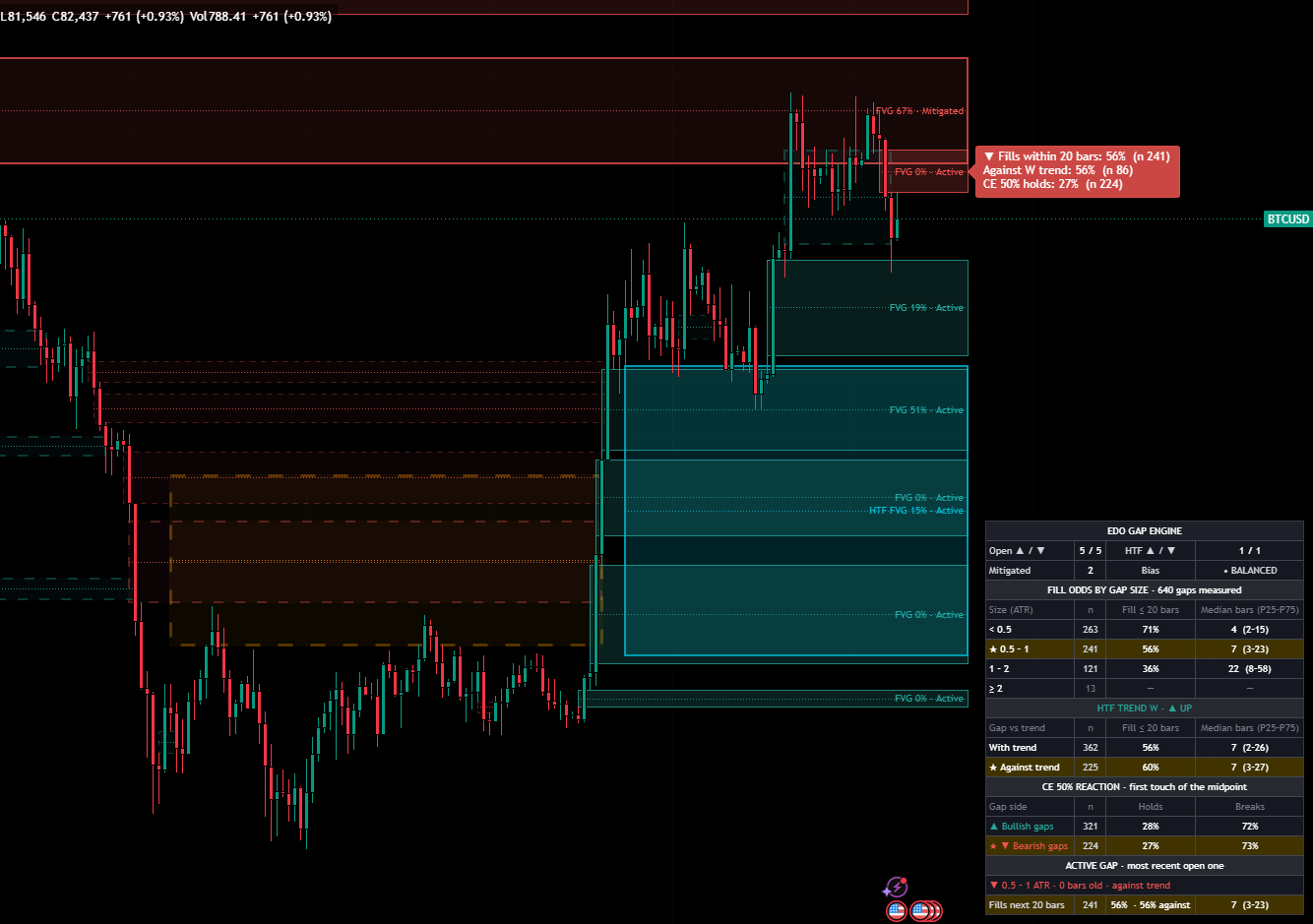
Edo Gap Engine draws every three-candle imbalance of the chart timeframe and of a higher timeframe as a zone, with its fill percentage and its state written inside. In the background it follows each gap in the chart's history until it fills or its tracking window ends, and turns that record into readings with the sample behind them: the share that filled within the horizon, the median time to fill, how often the 50% line held and how the figures change with the size and the age of the gap. The label next to the latest open gap shows those odds for gaps of its size, and the panel adds the same reading conditioned on its age. The one claim that could be an edge, the first retest of a gap traded in the direction of the gap, is kept apart and tested against random entries taken under the same rule. The indicator does not predict what the current gap will do. It shows how comparable gaps ended on this chart.
Edo Gap Engine works on any symbol and timeframe that has enough history to build a record, and the panel shows a dash where there is not. Detection holds the ATR length, the minimum gap size (0.25 ATR by default, which discards micro-gaps on any asset), the maximum gaps drawn per side, the fill rule (Wick or Close) and the ratio at which a gap counts as Mitigated. History Statistics sets the fill horizon, the tracking window, the minimum sample and the trend timeframe, and Evidence sets the target and stop in ATR, the cost model and the Plan percentages. Style and Panel cover colours, opacity, theme, four corners, three sizes, Full or Compact detail and the optional Side Table.
Manual included with your license
Trading involves risk. This indicator is an analysis tool and does not constitute financial advice, investment recommendations, or trading signals. The user is solely responsible for their trading decisions.
